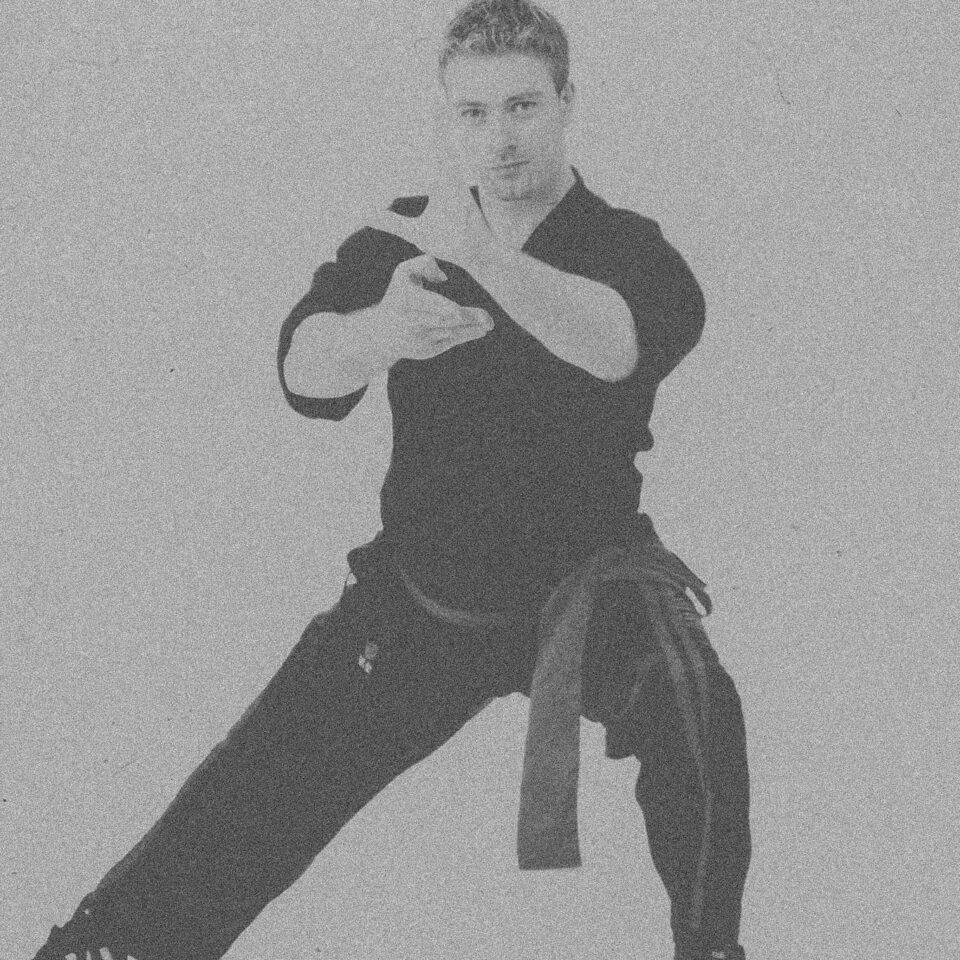



Building a highly elastic, “silk-like” fascial bodysuit requires patience and specific biomechanical strategies. Scientific research shows that connective tissue remodels much slower than muscle, taking two or more years of consistent, mild training to fully transform into a highly resilient and sensitive network.
To achieve this through solo training, you must move away from standard muscular isolation and apply specific types of strain to your body’s myofascial chains:
1. Isometric Holds and “Counter-Sinking” Fascial remodeling is stimulated by applying a gradual, consistent increase in strain. You can achieve this by holding static, semi-squatting postures (like standing meditation) for extended periods.
- Progressive Depth: Instead of forcing depth immediately, utilize the “counter-sink” protocol: hold a posture until comfortable, then sink slightly further. Sifu Cheng Tin Hung summarized this gradual conditioning as “one minute, one inch,” systematically increasing the load on the lower body.
- Added Resistance: Once proficient, you can increase the fascial strain by holding these postures while gripping heavy weapons, like a broadsword, spear, or iron rings.
2. Spiraling the Myofascial Chains Your solo movements must engage the longest possible continuous chains of connective tissue. This is achieved by abandoning linear movements in favor of multidirectional, fluid motions that incorporate constant spiraling, twisting, and coiling from the feet all the way out through the hands.
3. Pre-Tensioning (The Counter-Movement) To develop explosive, elastic power, you must utilize a “load and release” mechanism. Before executing any forward movement or strike, perform a slight “pre-tensioning” stretch in the exact opposite direction. In Tai Chi, this is often practiced as a complete weight shift from one foot to the other paired with a waist rotation (the “swing and return”), which actively winds up the elastic tension in the fascia.
4. Soft Bounces at the Extremes When you stretch and reach the absolute extreme limit of your current range of motion, perform a few repetitions of soft, elastic bounces. Doing these small bounces in a gentle, exploratory manner effectively stimulates the fibroblasts to remodel the tissue.
5. Smooth, “Silent” Movement Practice your solo forms with a focus on gradual deceleration followed by gradual acceleration. Moving as smoothly and elegantly as possible, while attempting to make absolutely no noise, forces your body to abandon jerky muscular contractions and fully recruit the fascial system for movement.
6. Spontaneous Shadow Fighting If you only practice set routines, your nervous system eventually “tunes out” the repetitive motions (sensorial dampening). To counter this, engage in unrehearsed, spontaneous shadow fighting. Mixing small, specific motions with large, extended movements forces you to constantly adapt, bringing proprioceptive awareness and fresh blood flow to neglected fascial areas.
7. The “Sponge” Recovery Principle This is a critical, often overlooked component of fascial training. During continuous, intense exercise, fluid is physically squeezed out of your viscoelastic fascia, causing it to lose its springy resilience. You must take short, periodic breaks during your solo sessions (such as walking slowly for a few moments) to allow the tissue to act like a sponge and reabsorb nourishing fluids.