


1. Historical and Philosophical Context
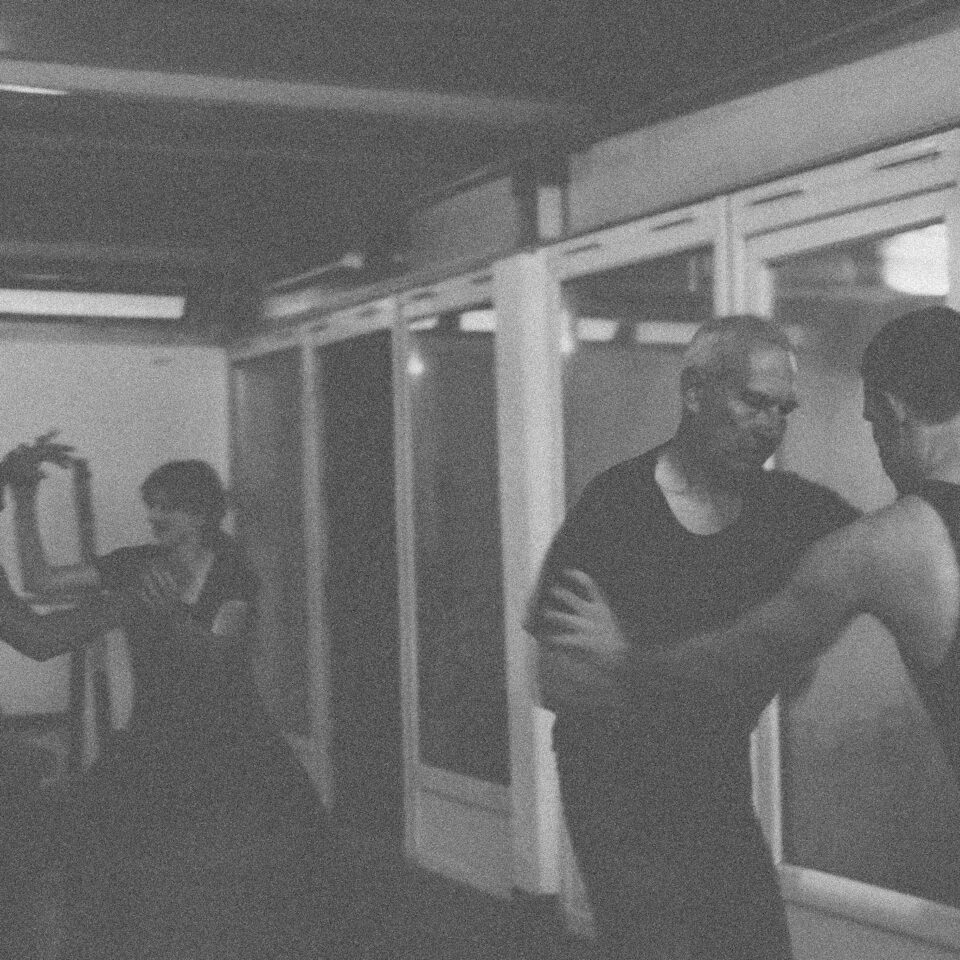
The art of Taiji originates within the Taoist gate, specifically preserved through the Wudang Neijia (Internal School) lineage. As a system designed for the dual cultivation of health and self-defense, its foundation rests upon the refinement of De (Virtue) and the practitioner’s moral character. Within the Wudang tradition, the transmission of these internal techniques is considered a sacred trust. Consequently, technical proficiency is secondary to spiritual integrity. To ensure the preservation of this legacy, all new initiates are required to perform a formal ritual of respect before the image of the Patriarchs and take a solemn, voluntary vow to uphold the sect’s internal regulations. This process filters out those with impure motives, ensuring the art remains a vehicle for “Superior Men” (Junzi) rather than those seeking mere combat or profit.
2. The Twelve Inner Rules: Full Translation and Analysis
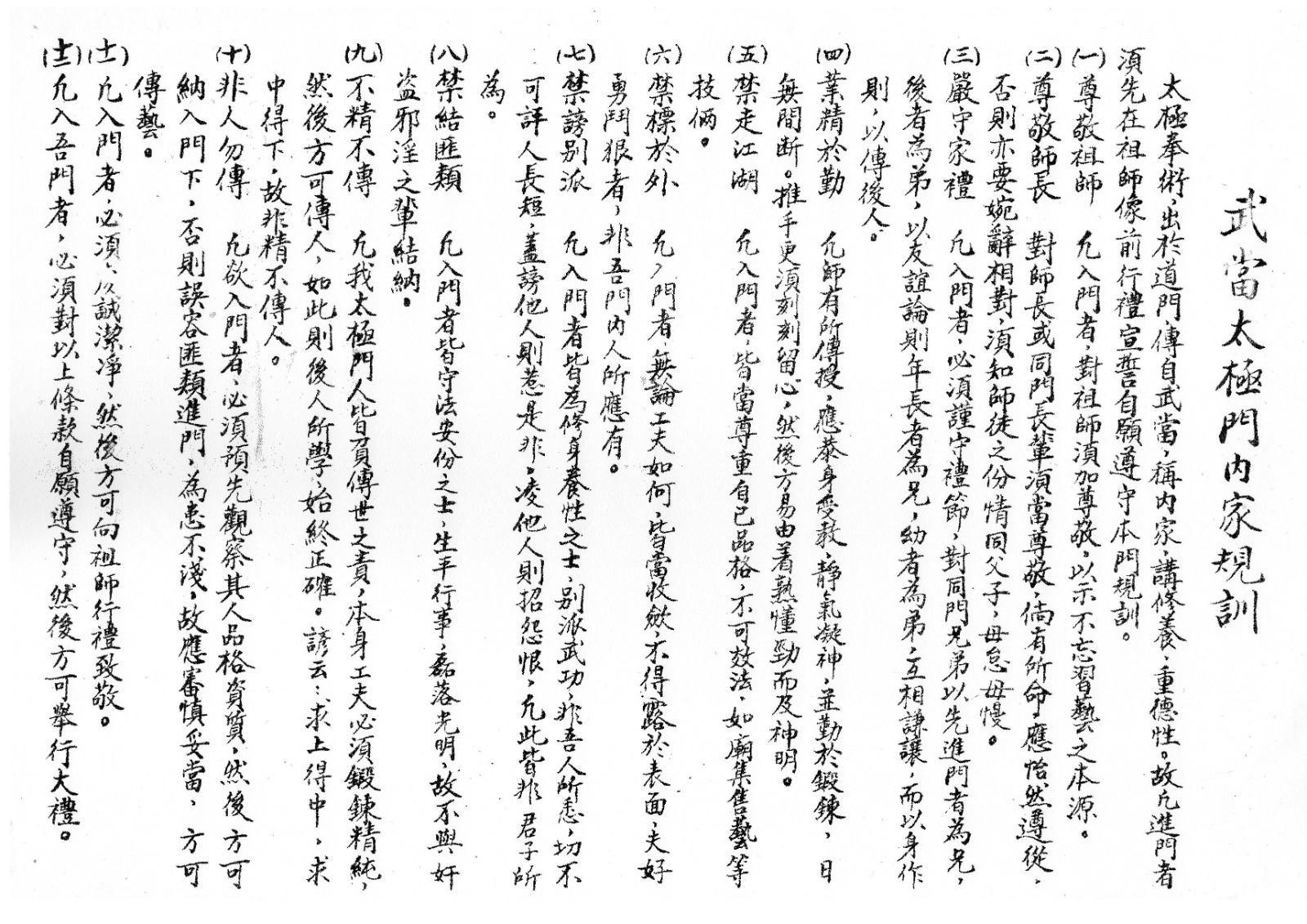
Rule I: Respect for the Patriarchs (尊敬祖師)
Translation: Upon entering the gate, the first priority is to pay respects before the image of the Patriarchs and take a vow to voluntarily abide by the sect’s rules. One must honor the Patriarchs to show that they have not forgotten the original source of the art. Analysis: This rule establishes the lineage’s vertical continuity. By acknowledging the “source of the art,” the practitioner submits to a tradition larger than themselves, mitigating the ego and fostering a sense of historical debt.
Rule II: Respect for Teachers and Elders (尊敬師長)
Translation: Respect must be shown to the teacher and senior brothers. One should honor them with the same affection and duty one owes to their own parents. If an elder gives an instruction or command, one should generally obey; however, if the command cannot be followed, one must respond with a “polite refusal” (wanci xiangdui). Analysis: The sect functions as a family (shimen). This rule balances absolute filial piety with a nuanced diplomatic mechanism. The inclusion of wanci xiangdui allows for personal boundaries within a hierarchical structure, ensuring that obedience does not lead to unethical behavior.
Rule III: Strict Observance of Etiquette (嚴守禮節)
Translation: Within the gate, one must strictly observe the codes of etiquette. Seniority is determined solely by the order of entry: those who entered earlier are the “elder brothers” (xianjin zhe wei xiong), and those who followed are “younger brothers.” One must be humble and yielding, using personal conduct to set an example for others. Analysis: Unlike secular society, where age or wealth might dictate status, Wudang seniority is meritocratic based on time dedicated to the art. This enforces a “first-in, first-senior” rule that stabilizes the internal hierarchy and prevents social competition from disrupting the training environment.
Rule IV: Diligence in Mastery (業精於勤)
Translation: Mastery is found in diligence. One must be dedicated to constant practice, focusing on the refinement of spirit, energy, and spirit (jing, qi, shen) without interruption. In Tui Shou (Push Hands) practice, one must be mindful at every moment; only then can one easily transition from “familiarity with techniques” (zhuo熟) to “understanding energy” (dong jin) and finally to “spiritual illumination” (shenming). Analysis: This rule outlines the technical trajectory of the Neijia arts. It emphasizes that Tui Shou is not merely a drill but a meditative path. The milestones of zhuo, dong jin, and shenming represent the evolution from physical mechanics to a state of intuitive, spiritual mastery that transcends the physical form.
Rule V: Prohibition of Public Exhibitionism (禁走江湖)
Translation: All who enter this gate are forbidden from wandering the “rivers and lakes” (jianghu) as street performers or buskers for profit. One must respect their own dignity and not treat the art as a common trade for entertainment. Analysis:Historically, Jianghu referred to the itinerant world of martial artists and performers. By forbidding “wandering,” the Wudang sect sought to distinguish its practitioners from low-status street entertainers, preserving the art’s reputation as a high-level Taoist pursuit rather than a public commodity.
Rule VI: Prohibition of Ostentation (禁標於外)
Translation: It is forbidden to display one’s skills externally. No matter how great one’s ability, it must be kept hidden and not revealed on the surface. To be aggressive, boastful, or harsh toward others is not what the Wudang school represents. Analysis: This reinforces the “Internal” (Nei) nature of the art. True power is to be concealed. Boastfulness is viewed as a leak of internal energy and a failure of the self-restraint necessary for deep cultivation.
Rule VII: Refraining from Slandering Other Schools (禁謗別派)
Translation: It is forbidden to criticize or slander other martial arts lineages. Those who enter this gate do so to cultivate their own bodies and nurture their nature. If one spends their time inciting conflict or speaking of others’ faults, they invite resentment. Such behavior is not that of a Junzi (Gentleman/Superior Man). Analysis: The focus is on internal progress. By referencing the Junzi, the text aligns Taiji practice with Confucian-Taoist ethics, suggesting that disparaging other styles is a sign of an unrefined character and a distraction from the goal of xiushen (self-cultivation).
Rule VIII: Avoidance of Corrupt Company (禁結匪類)
Translation: All who enter this gate must be law-abiding and duty-fulfilling (shoufa anfen) citizens. One must never associate with criminals, bandits, or those of depraved character. Analysis: This rule served a dual purpose: protecting the practitioner’s moral fiber and protecting the sect from political or imperial scrutiny. By emphasizing shoufa anfen, the sect ensured its members were seen as productive, non-threatening members of society.
Rule IX: Mastery Before Transmission (不精不傳)
Translation: The transmission of our Taiji art carries the heavy responsibility of passing it through generations. One’s own skill must be forged until it is pure and perfected before one can teach. As the saying goes: “Seeking the top, one gets the middle; seeking the middle, one gets the bottom.” If the skill is not refined, it must not be transmitted. Analysis: This pedagogical warning ensures the art does not degrade over time. The proverb illustrates the “entropy of transmission”—if a teacher is only 50% proficient, their student will only reach 25%. Purity of the lineage requires the master to reach the highest level before attempting to act as a conduit.
Rule X: Selectivity in Teaching (非人勿傳)
Translation: The art must not be taught to the unworthy. One must first observe a potential student’s character and innate qualities. Only then may they be admitted. Admitting the wrong person brings “no small amount of trouble” (wei huan bu qian), so one must be cautious and prudent. Analysis: The master is the gatekeeper. This rule warns that teaching a person of poor character—someone who might use the art for harm or crime—ultimately reflects on the teacher and the lineage, potentially leading to the sect’s downfall.
Rule XI: Purity of Intent (凡入門者,必須誠潔淨)
Translation: Every person entering the gate must possess a heart that is sincere, clean, and pure; only then may they pay respects to the Patriarchs. Analysis: This rule establishes a ritual prerequisite. It demands an internal “cleansing” before the external ritual can take place. Without cheng (sincerity), the physical act of bowing is considered empty and invalid.
Rule XII: Vow of Compliance (凡入吾門者,必須對於以上各條款自願遵守)
Translation: All who enter my gate must voluntarily pledge to follow all the above rules and regulations; only then may the formal initiation ceremony proceed. Analysis: The voluntary nature of the vow (ziyuan) is paramount. It ensures that the disciple is a conscious participant in their own moral regulation, creating a binding psychological contract between the practitioner and the lineage.
3. Summary of Ethical Standards
| Theme | Rules Included | Objective |
| Ritual Prerequisites | XI, XII | To ensure the practitioner’s heart is pure and their commitment is voluntary before formal entry. |
| Interpersonal Ethics | I, II, III | To maintain lineage continuity and a harmonious hierarchy based on entry order (Xianjin zhe wei xiong). |
| Personal Cultivation | IV, VI, VII | To achieve technical milestones (Shenming) through diligence while maintaining the humility of a Junzi. |
| Social Responsibility | V, VIII, IX, X | To protect the sect’s reputation, ensure civic duty (Shoufa anfen), and prevent the “entropy of transmission.” |
Consequences of Non-Compliance
- The Degradation of Quality: As warned by the proverb in Rule IX, failing to achieve mastery before teaching leads to a “seeking the middle, getting the bottom” effect, eventually diluting the art until its internal essence is lost.
- The Incurring of Resentment: Slandering other schools or behaving aggressively (Rule VII) invites external conflict and hostility, which disrupts the peace required for internal cultivation.
- Pollution of the Lineage: Admitting individuals of poor character (Rule X) brings “no small amount of trouble,” potentially turning the art into a tool for criminality and inviting legal or social destruction upon the sect.
- Spiritual Stagnation: A lack of diligence or a heart that is not “clean and pure” (Rule XI) prevents the transition from mere physical technique to the higher states of Dong Jin and Shenming.