


1. Introduction to the Practical Tai Chi Lineage
The “Practical Tai Chi Chuan” system, as codified by Grandmaster Cheng Tin Hung, is an elite combat methodology rooted in the Wudang Mountain lineage of Zhang Sanfeng. Unlike purely aesthetic interpretations of the art, this system is a proven tactical framework. Cheng Tin Hung established his undisputed authority in 1957 during a high-profile competition where he defeated the Taiwan champion, Yu Wen-tung, by a great margin (絕大比數). The following guide is based on his writings.
The system’s combat efficacy was further validated through the performance of Cheng’s disciples on the international stage. In 1971, his team secured the overall championship in Taipei. This dominance continued into the 1980s, with practitioners like Tang Chi-kin and Dan Docherty securing gold medals in the international Chinese full contact martial arts invitationals in Malaysia. As a tactical combat analyst, I define this lineage not by its slow forms, but by its history of neutralizing “hard” styles through sophisticated internal mechanics. Eventually Cheng’s t’ai chi fighters achieved 31 victories from 32 matches, an astounding 98% success rate in the bloodbaths of full contact lei tei fighting.
2. The Psychological Foundations of Self-Defense
Combat success is predicated on emotional regulation and the exploitation of the “Void.”
- Emotional Control (Qingjing): To maintain logical reasoning under the stress of a life-threatening confrontation, the practitioner must achieve a state of Qingjing (tranquility). Impulsive movements, triggered by a primitive fear-response, suppress the ability to execute precision maneuvers.
- Observational Strategy: Before the kinetic phase begins, the defender must “investigate” the opponent. This is a cold assessment of the attacker’s stance, weight distribution, and intent, identifying the “empty” line of their structure before they strike.
- The Theory of “Wu” (The Void): Drawing from the Tao Te Ching, we utilize the concept of “the softest thing in the world galloping through the hardest.” This is not metaphorical; it is tactical. The source explicitly compares this to modern physics: just as gamma rays can penetrate solid matter because they inhabit the “Void” (Wu), the Tai Chi practitioner uses internal “softness” to infiltrate and dismantle an attacker’s rigid force.
3. Core Theoretical Principles of Engagement
For the tactical practitioner, the following rules govern every engagement. Failure to adhere to these principles results in structural collapse:
- Yielding and Adhering (黏 / 走): You must “stick” (Nian) to the opponent to maintain tactical data via touch (Ting Jing or Listening Energy) and “walk/yield” (Zou) to dissolve their incoming momentum.
- Avoiding “Double Weighting” (雙重): This is the most catastrophic error. Clashing force directly against force creates a stalemate that favors the stronger individual. By remaining “hollow” where the opponent is “solid,” you compromise the attacker’s base and gain control of the kinetic chain.
- The Use of Arcs and the Waist: All defensive and offensive actions must be circular. Linear resistance is easily countered; however, a circular movement powered by the rotation of the waist acts as a centripetal force, allowing “four ounces to deflect a thousand pounds.”
4. Ready Stances for Combat Preparation
Tactical readiness is achieved through two primary stances, designed to minimize the target profile and maximize rotational speed:
- Stance I (Lead Foot Forward): One foot is placed forward to create a stable yet mobile base. The weight is distributed to allow for immediate shifting between “Full” and “Empty.”
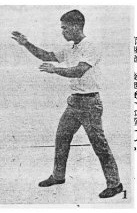
- Tactical Advantage: The hands are positioned at the center line to shield the throat and chest. These stances are optimized for rapid waist rotation, allowing the defender to evade high-velocity strikes and transition into a counter-attack without losing equilibrium.
5. Technical Execution: Defensive Maneuvers
Practical Tai Chi focuses on neurological disruption and the exploitation of anatomical vulnerabilities.
5.1. Escape from a Rear Choke/Neck Lock
When an attacker applies a rear choke or neck lock, the defender must act within the first second to prevent unconsciousness:
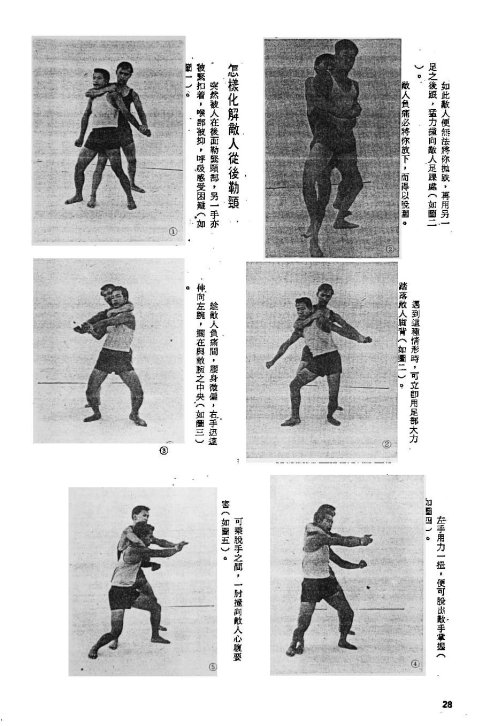
- Lower the Center: Sink the weight immediately to ground the structure.
- Wrist Control: Use the left hand to pull the attacker’s wrist downward, creating a gap for airflow.
- Distraction Strike: Deliver a heavy stomp to the attacker’s instep.
- Waist Rotation: Sharply pivot the waist to create space within the lock.
- Neurological Counter-Strike: Deliver a sharp elbow strike to the heart or solar plexus.
- Pressure Point Termination: Use the fingers to strike the Acoustic Point (天容穴 – Tianrong) behind the ear or the Temple (太陽穴 – Taiyang) to induce structural collapse.
5.2. Countering Rear Grabs Over the Arms
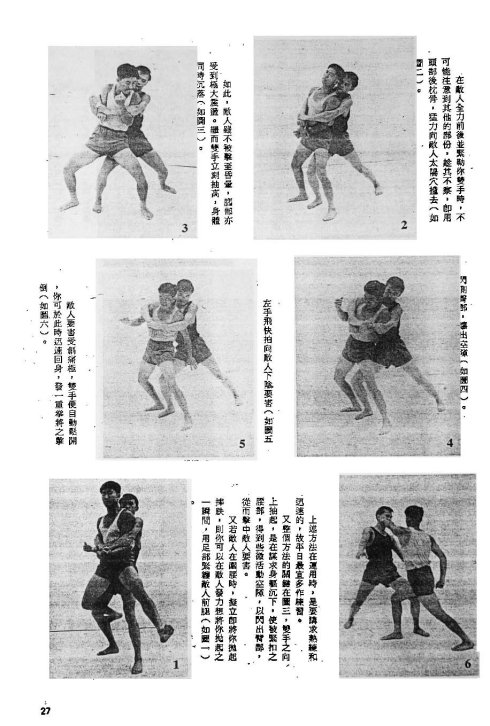
If grabbed from behind over the arms, do not fight the grip directly; expand the frame:
- Sinking Movement: Drop the center of gravity to compromise the attacker’s leverage.
- Frame Expansion: Broaden the shoulders and expand the back to create tension against the grip.
- Primary Strike: Rotate and strike the Temple (太陽穴 – Taiyang) with force.
- Secondary Strike: Follow up immediately with a left-hand strike to the groin or lower abdomen to finalize the disruption.
5.3. Throws and “Die Pu” (跌撲) Strategies
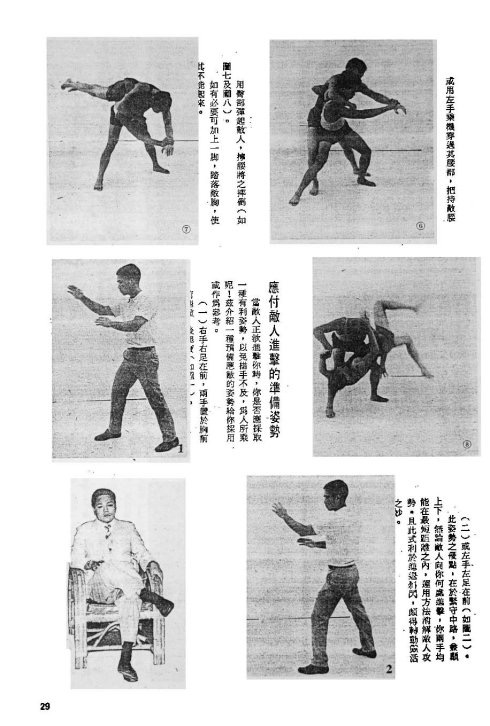
The forms “White Crane Spreads Wings” and “High Tan Horse” are highly effective Die Pu (跌撲) or throwing maneuvers when applied with the “False Move” strategy.
- High Tan Horse (高探馬): Use a “virtual” or false High Tan Horse high to distract the opponent. As they react to protect their head, you land the real strike or throw at the middle or lower gate.
- White Crane Spreads Wings (白鶴晾翅): This is used to “shed” a grab. The expansion of the arms in opposite vertical directions disrupts the opponent’s center of gravity, causing them to fall along their diagonal line of weakness.
6. Training for Combat: The Integrated Approach
An experienced t’ai chi martial artist understands that technical skill is useless without the internal power to support it.
- The Five Disciplines: Comprehensive training requires Tai Chi Chuan (forms), Push Hands (sensitivity), San Shou (sparring), Die Pu (跌撲 – grappling/falls), and Neigong.
- Internal Power (Neigong): Following the 12-stage chart the practitioner builds the “capital” of combat. Stage 1, Golden Tortoise (金龜式), is essential for “firming the body” to withstand impact. Stage 4, Jade Rabbit (玉兔朝華), “sinks the Qi to the Dan Tian,” providing the root necessary for generating Rou Jing (柔勁 – Flexible Power).
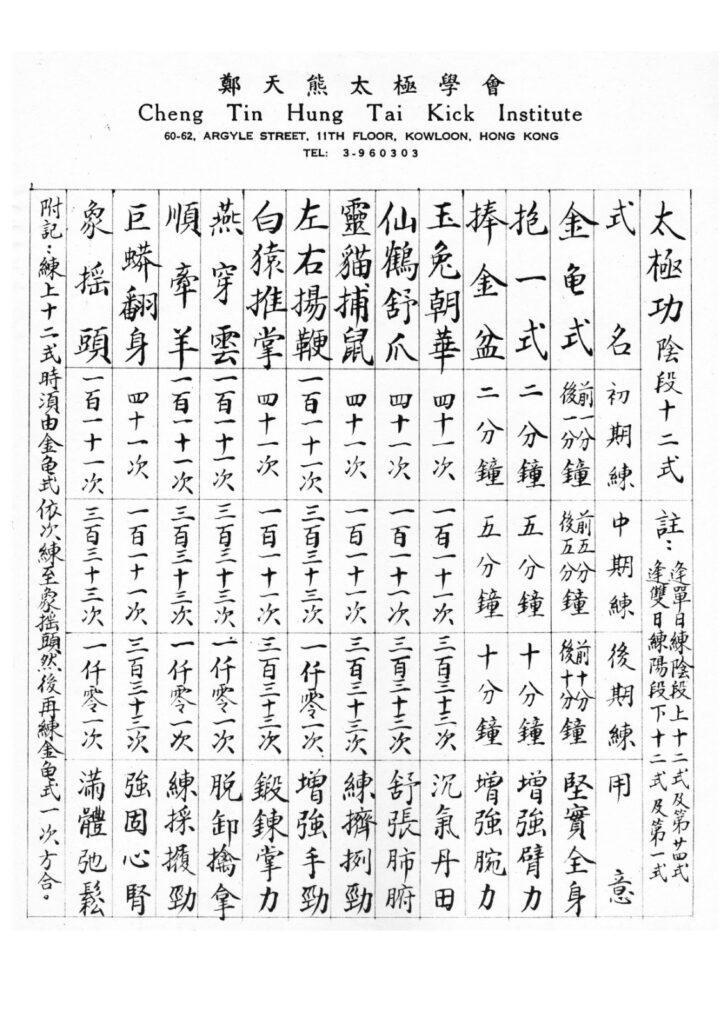
- Ting Jing (Listening Energy): Developed through Push Hands, this allows a practitioner to anticipate an attacker’s kinetic intent through touch, responding before the strike is fully realized.
7. Strategic Conclusions for the Practitioner
The “Practical Tai Chi” philosophy is defined by “choosing the near path over the far path” (捨近求遠). This dictates a path of least resistance and maximum efficiency. Attempting to overcome an attacker with raw muscular force is “seeking the far path” and is a tactical failure.
As outlined on Page 43, technical skill is merely a “business plan.” Neigong (Internal Power) is the “capital.” A businessman with a brilliant plan but no capital will fail; likewise, a practitioner with technical knowledge but no internal durability or Rou Jing cannot execute effectively in a high-stakes confrontation. Technical mastery must be supported by the internal “capital” of a resilient body and a calm, tactical mind.