


The Evolution of Form: Mastering Sequence and Spontaneity in T’ai Chi Practice
1. The Strategic Foundation of Internal Motion
T’ai Chi Chuan is not merely a regimen for health, but a “Transcendent Art” constructed upon a robust internal architecture of Taoist philosophy. Within the sisterhood of the internal arts—comprising Tai Chi Chuan, Hsing Yi Chuan, and Pa Kua Chang—the strategic primacy of solo posture work cannot be overstated. Whether through the stillness of standing meditation or the dynamic undulations of form, solo practice serves as the essential vehicle for the expression of internal power and the cultivation of meditative flow. The master’s objective is the distillation of immutable standing principles, which are subsequently projected into hundreds of distinct shapes. While these core principles remain fixed, the practitioner’s journey demands a dual-layered approach: first, the mastery of the disciplined sequence, and ultimately, the transcendence of that scaffolding through spontaneous motion.
2. The Disciplined Path: Practicing the Long Sequence
The solo practice sequence functions as a physical syllabus, providing the structural integrity required to move from a novice’s mimicry to a scholar’s understanding. In the lineage of masters such as Cheng Tin Hung, this is codified through a rigorous curriculum, including the 72-move saber and the specialized Tai Chi Internal Gong 12 Sections (太極功陰段十二式). This disciplined repetition serves a specific physiological and energetic purpose.
Initially, the student must “learn the appearance,” ensuring that every posture is firm and structurally aligned. This is followed by “learning the breath,” where movements achieve a seamless smoothness. The sequence is designed with explicit health objectives derived from the classics: strengthening the whole body’s bones, increasing lung capacity through the expansion of the chest and viscera (Shu Zhan Fei Fu), and sinking the Qi to the Dantian.
Strategically, the fixed sequence is the primary defense against the “greatest taboo” of the internal arts: double-weighting. This error creates stagnation and rigidity, rendering the practitioner unable to transform energy. By meticulously distinguishing between the substantial (Shi) and the insubstantial (Xu), the student learns to abandon the self to “follow the opponent.” Only once the “appearance” is firm and the “breath” is smooth can the practitioner transcend the scaffolding of the form and approach the secret wisdom.
3. The Fluid Path: Spontaneous and Creative Practice (Danlian)
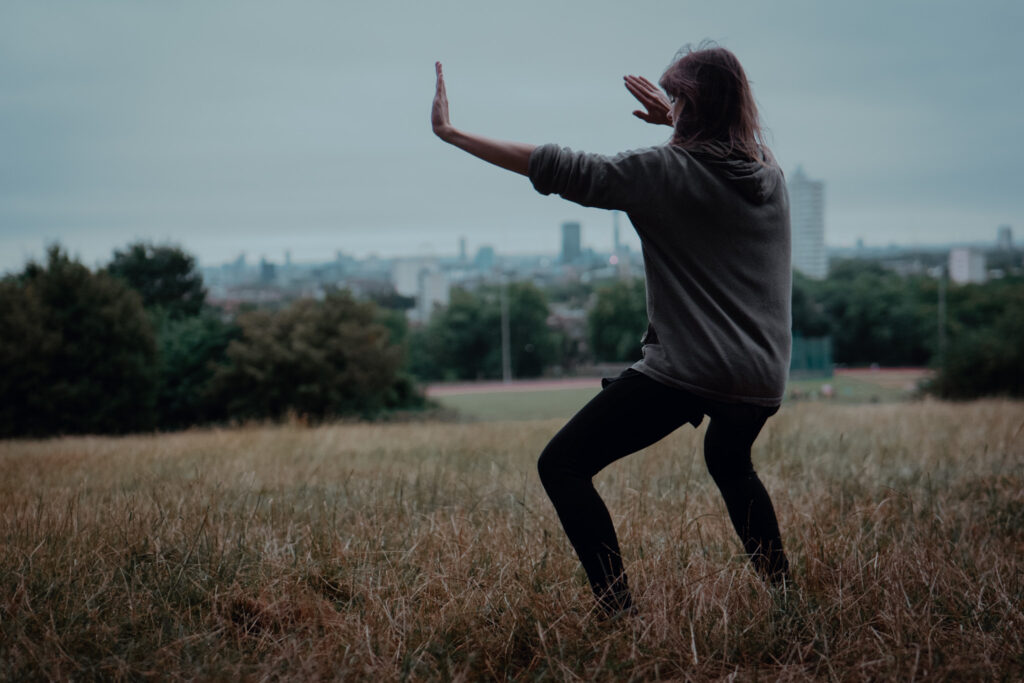
As the practitioner matures, the method of Danlian (solo practice) evolves into a higher modality of training where the student transitions from a follower of forms to an architect of motion. This creative path is not a descent into random movement; rather, it is a state where the “mind leads the law.” The practitioner may select three or five specific exercises, performing them without respite, or eventually move “at will” according to the dictates of the imagination.
There is a profound progression in this solo work that links physical execution to internal revelation. If one does not understand the “law”—the governing principles of the art—they are merely wasting time practicing the appearance. The mastery of this progression is essential:
“Without practicing the appearance, the appearance is not firm. Without practicing the breath, the breath is not smooth. Without practicing the secret wisdom, the secret wisdom is not active. Without practicing the law, the law does not break through… When practicing at will, the secret wisdom becomes active and the law becomes round.”
When the “law” becomes round, the practitioner’s movements are no longer calculated; they are a living, spontaneous manifestation of the art’s essence.
4. The Immutable Principles: Posture and Internal Mechanics
Regardless of whether one adheres to a rigid 72-move choreography or engages in spontaneous Danlian, the “Four Important Points of Solo Practice” remain non-negotiable. These internal mechanics are the only means by which a practitioner can clear the “interference” that prevents high-level application.
- Head Position: The head must remain upright (Ding Tou Xuan), allowing its weight to sit correctly on the spine. This alignment ensures the mind remains clear and the spirit can rise.
- Sinking and Relaxing: One must consciously “sink the shoulders” and “drop the elbows.” Any tension in these gates creates a blockage that prevents power from reaching the extremities.
- Waist Flexibility: The waist is the “axis” or “wheel” of the entire body (Yao Ru Che Zhou). All movement must be governed by this central axle to produce cohesive power.
- Clarity of Weight: The constant differentiation of weight prevents stagnation. This clarity allows for the transformation of energy required to “stick” (Nian) to an opponent.
These postural requirements directly refine the “reflex nerve.” When the internal architecture is clear of tension, the brain can grasp the opponent’s intention and angle of approach before the physical contact is even completed. This neurological speed is the hallmark of the master.
5. Conclusion: Toward a Transcendent Art
The evolution of the practitioner is a journey from the “beginner procedure” (chulian)—the study of the “eight doors” and “five steps” held in the stillness of meditation—to the long sequence, and finally to the imagination-based practice of Danlian. We honor the historical weight of this transmission, from the legendary Yang Luchan to Li Ruidong, who received the “true transmission” from Wang Lanting, and through to modern luminaries like Cheng Tin Hung.
The ultimate aim is to reach a state where “the mind leads the law,” transforming T’ai Chi from a mere exercise into a Transcendent Art. This transformation requires more than physical repetition; it demands multiple thoughts and constant research. To truly understand the “law,” one must be committed to daily diligence, ensuring that every movement, whether fixed or spontaneous, is a reflection of the deep, living wisdom of the internal arts.