

1. More Than Just a Sword Dance
When you see a group in the park practicing Tai Chi, you likely see the slow, gentle flow of the hand form. But in our lineage—the tradition of Great Master Cheng Tin Hung—we know that Tai Chi is much more than a “slow-motion exercise.” It is what the Master called a “transcendent art.”
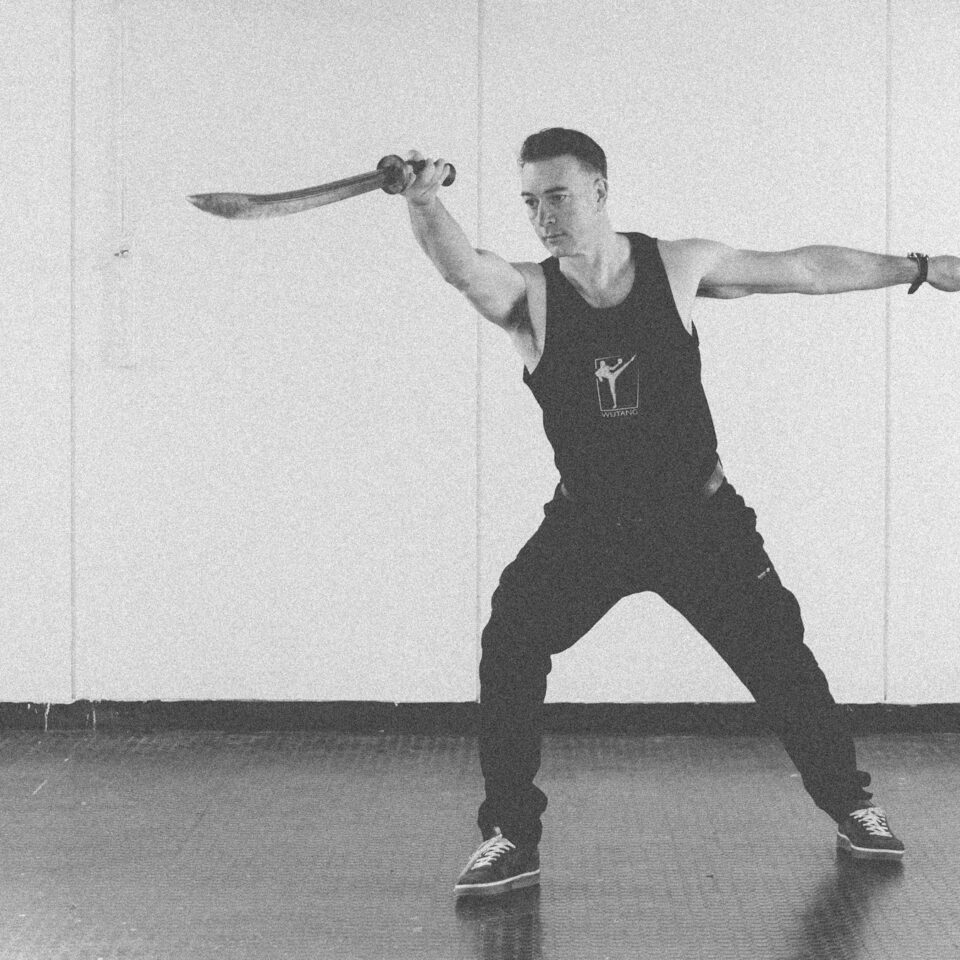
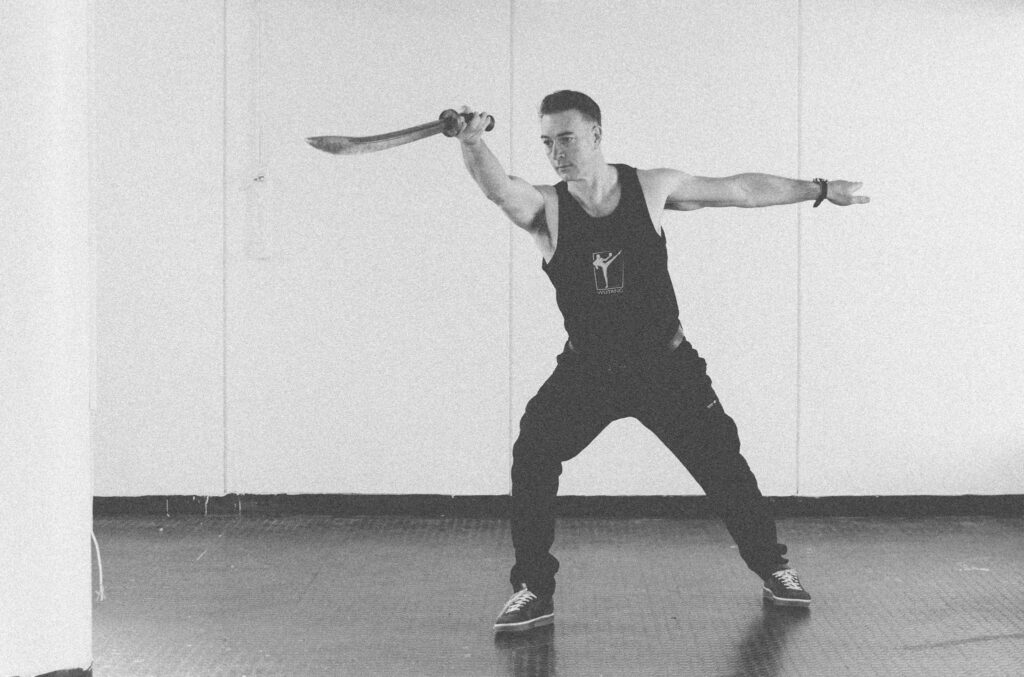
Adding the Tai Chi Sabre (Dao) into your practice shifts the energy entirely. It introduces weight, momentum, and a dynamic martial edge that builds a unique kind of self-confidence. You aren’t just waving a blade; you are learning to extend your intent through an object, finding a balance between rigorous application and meditative serenity.
2. The Internal Science: Why It Works for Your Body
In our school, we don’t separate health from combat; they are two sides of the same coin. The effectiveness of the Sabre is rooted in “Internal Science.” Here is how this practice provides you with what I call “The Physiological Edge”:
- Forging the Skeleton: In Traditional Chinese Medicine, the kidneys govern the bones. By maintaining the deep, grounded stances of the Sabre form, we “tonify the kidneys” and literally strengthen the bone structure. It’s an internal way to build a resilient frame.
- Training the Reflex Nerves: We perform the 72 movements in a “meditative manner,” but don’t let the calm fool you. Managing a weapon trains your sensitivity and your “reflex nerves.” This builds the reaction speed you need to stay sharp and responsive under pressure.
- The Power of Postural Integrity: To move the blade without injuring yourself, you must master Dui(correct) postures. We focus on Han Xiong Ba Bei—emptying the chest and plucking the back—to ensure energy flows freely. We keep the head suspended as if from a string and avoid the Cuo (incorrect) mistakes of a protruding chest or a collapsed spine, which lead to “stagnant” energy.
3. The Martial Logic: Sensitivity and the “Four Ounces” Rule
The Sabre teaches you that true strength isn’t about muscle; it’s about listening. If you meet a thousand pounds of force with force, you break. Instead, we follow the “Tai Chi Classics.”
Sticking and Adhering (Zhan Lian Nian Sui) The Sabre is your teacher in the art of connection. By Sticking and Adhering, you learn to “use four ounces to deflect a thousand pounds.” By staying attached to your opponent’s movement, you can “lead them into emptiness,” redirecting their power back at them.
Avoiding Double Weighting (Xu vs. Shi) The greatest trap in martial arts is “Double Weighting.” This isn’t just about how you stand; it is a failure to distinguish between Shi (Substantial) and Xu (Insubstantial). If you are double-weighted, you are stagnant and clumsy. Sabre training demands that you constantly shift between substantial and insubstantial, giving you the agility to change your position the moment an attack arrives.
4. From Ancient Steel to the Modern Umbrella: Everyday Applications
You probably don’t walk around with a steel Dao, but the Shen Fa (Body Method) you learn from the 72 movements—with names like “Cloud Dragon Plays with Water” and “Looking at the Moon”—stays with you. The leverage and circularity of the Sabre translate perfectly to common objects.
| Traditional Weapon | Everyday Object | Training Benefit |
|---|---|---|
| Tai Chi Sabre (Dao) | Walking Stick / Umbrella | Provides reach, leverage, and defensive “sticking” capabilities. |
| Single Heavy Blade | Rolled Magazine / Short Ruler | Focuses on “short power” and developing essential wrist strength. |
5. Emergency Readiness: With or Without an Object
The “secret” we teach is that weapon training actually makes your unarmed combat stronger. The way you swing a sabre—using the coordinated power of the waist and legs—is the same way you escape a dangerous hold.
- Deflecting Attacks: The circular parries of the Sabre form allow you to catch a punch and lead it into empty space, unbalancing the attacker.
- Mechanical Escapes: If someone grabs you in a bear hug or a neck choke, you don’t fight their grip. You use the leverage developed in weapon training. By using your “buttock” to unbalance their center or striking the opponent’s leg with your knee (as shown in our traditional manuals), you create the opening needed to escape a stronger opponent without relying on raw muscle.
6. The “Secret Wisdom” of Wellness and Confidence
People often ask me for “Secret Wisdom.” I tell them it isn’t magic—it’s the active result of practicing the “Eight Doors” and “Five Steps” through three pillars: Appearance, Breath, and Law.
Listen closely: the Law (the underlying principle) creates the Appearance (the move). Without the Law, the move is empty and won’t “break through.” Without the Breath, your movement isn’t smooth. When you practice all three in unison, you reach the state of “Transcendent Art.” You gain more than just a self-defense skill; you gain a profound sense of wellness and the “self-confidence” to handle any emergency with a calm, focused mind.
You don’t need a martial arts hall to start. Pick up a sturdy umbrella or a walking stick today. Try just one slow, flowing circle. Focus on “sinking the Qi to the Dantian”—that physical and energetic center of gravity located just below your navel. Feel the weight of the object, feel your breath settle, and experience the serenity that comes when you stop fighting the world and start flowing with it.
Mastery of the T’ai Chi Sabre:A Comprehensive Online Course in Internal Power and Health
Xuan Xuan Dao: profound and mysterious Sabre
The Strategic Genesis of Internal Practice
The T’ai Chi Sabre is far more than a historical artifact or a mere prop for performance; it is a sophisticated biomechanical accelerator designed for advanced “energy cultivation” and “health preservation.” In the modern professional landscape, where the “hectic lifestyle” frequently results in physical stagnation and psychological burnout, this practice offers a strategic intervention.