


Imperative of Martial Lineage
In the high-stakes environment of traditional combat systems, “lineage” is far more than a genealogical record; it is a verified transmission of specialized, high-value knowledge. For the serious practitioner, a documented lineage serves as a vital quality-control mechanism, ensuring that the martial efficacy of the art has not been diluted into mere aesthetic performance. Within this tradition, we view the acquisition of skill through the lens of a strategist.
Central to this strategic framework is the concept of “Martial Capital.” Consider a business owner who requires financial capital to execute complex plans; similarly, a martial artist requires “Internal Power” (Nei Kung) to execute technique.
Without this capital, even the most sophisticated “plans” (techniques) remain hollow and unworkable under pressure. A high-quality lineage specifically hedges against “Double-Weighting” (Shuang Zhong), a fundamental error described in the source as a product of emotional agitation and nervousness.
This psychological panic triggers a “force-against-force” instinct (以力抗力), causing the practitioner to become stiff and stagnant. By investing in a proven lineage, the student acquires the technical and psychological discipline to remain “Void” or “Solid” as required, preventing the stagnation that leads to defeat. This practical evolution is rooted deeply in the strategic soil of Taoist philosophy.
Taoist Foundations: Chang San Feng and the Theory of Softness
The origins of this art are anchored in Wudang Mountain, where the legendary cultivator Chang San Feng observed the natural world to derive a system of combat that transcends brute strength. Chang San Feng’s contribution was the synthesis of I Ching (Book of Changes) philosophy with physical technique, creating a methodology that aligns the human body with the immutable laws of nature.
This alignment is articulated through the “Theory of Softness” found in the Tao Te Ching. As the source context highlights, “the most soft in the world can ride over the most hard.” In a combat strategy, this is expressed through Wu Wei(Non-action), which is not passivity, but rather a state of “clear and quiet”理智 (rationality) that allows one to respond to an opponent’s momentum without impulsive force.
T’ai chi masters have described this “Ultimate Softness” (至柔) as being like water or gamma rays—capable of penetrating the most solid structures through precision and flow.
The I Ching dictates the mechanical shifts of the art through a specific progression of hexagrams. The transition from Kun(Earth/Pure Softness) through Fu, Lin, Tai, Da Zhuang, and Guai to Qian (Heaven/Pure Hardness) represents the “advance of Yang and retreat of Yin.”
This sequence provides the technical basis for weight shifting and the application of intent; as the practitioner moves, they navigate these philosophical states to ensure every mechanical change is a reflection of the natural cycle of change. These ancient theories were eventually carried from the mountains and refined into the elite technical systems of the Qing Dynasty.
The Royal Transmission: Wang Zong Yue and the Bridge to Modernity
During the mid-to-late Qing Dynasty, the art transitioned into the imperial circles of Beijing, a period of immense strategic importance. It was here that the lineage of the master Wang Zong Yue found its most famous expression through his successor’s disciple, Yang Lu Chan. Yang Lu Chan famously “famed the art in Beijing” (誉满京华), proving its efficacy within the highest echelons of the imperial power structure.
This “Royal Transmission” was essential for maintaining the “Practical” essence of the art during a period of expanding popularity. While public versions of Tai Chi began to focus on health-oriented forms, the lineage preserved by figures like Wang lan ting and eventually passed through the masters of the 20th century, demanded the retention of Nei Kung(Internal Power) and direct martial application.
Wang Lan Ting (王蘭亭) was a highly skilled, direct student of the legendary Tai Chi master Yang Lu-ch’an. His most significant contribution to the martial arts world was serving as the vital, unbroken link that preserved and transmitted a highly effective branch of Tai Chi, which ultimately became the Practical Tai Chi system.
After developing outstanding martial arts abilities under Yang Lu-ch’an, Wang was involved in a fatal incident with several Manchurian Bannermen and was forced to flee for his life. He shaved his head and went into hiding as a Buddhist monk, taking the name Fa Jing (法淨). Because the public was deeply afraid of the Qing dynasty authorities, his name became a taboo subject and was rarely spoken.
Under these extreme circumstances, his knowledge could have easily been lost to history. However, Wang Lan Ting’s crucial contribution was that he secretly ensured the survival of his art by passing his complete Tai Chi skills on to a fellow monk, Master Jing Yi (靜一大師).
This act of preservation allowed the lineage to continue, as Master Jing Yi later transmitted the art to Qi Minxuan, who in turn taught Master Cheng Tin Hung. Without Wang Lan Ting’s dedication to passing on the art while in exile, the specific combat and internal power methods of Practical Tai Chi might not exist today.
This rigorous standard ensured the art arrived in the modern era as a battle-tested system.
Qi Min Xuan: The Modern Catalyst for Practicality
Qi Minxuan, who was also known by his Daoist title Zhi Meng Ju Shi (智孟居士), later became the crucial link in this lineage by passing these practical combat and internal power (Neigong) skills directly to Master Cheng Tin Hung, the founder of Practical Tai Chi.
In 1946, Cheng Tin Hung first met Master Qi Minxuan through his uncle and teacher, Cheng Wing-kwong (鄭榮光).
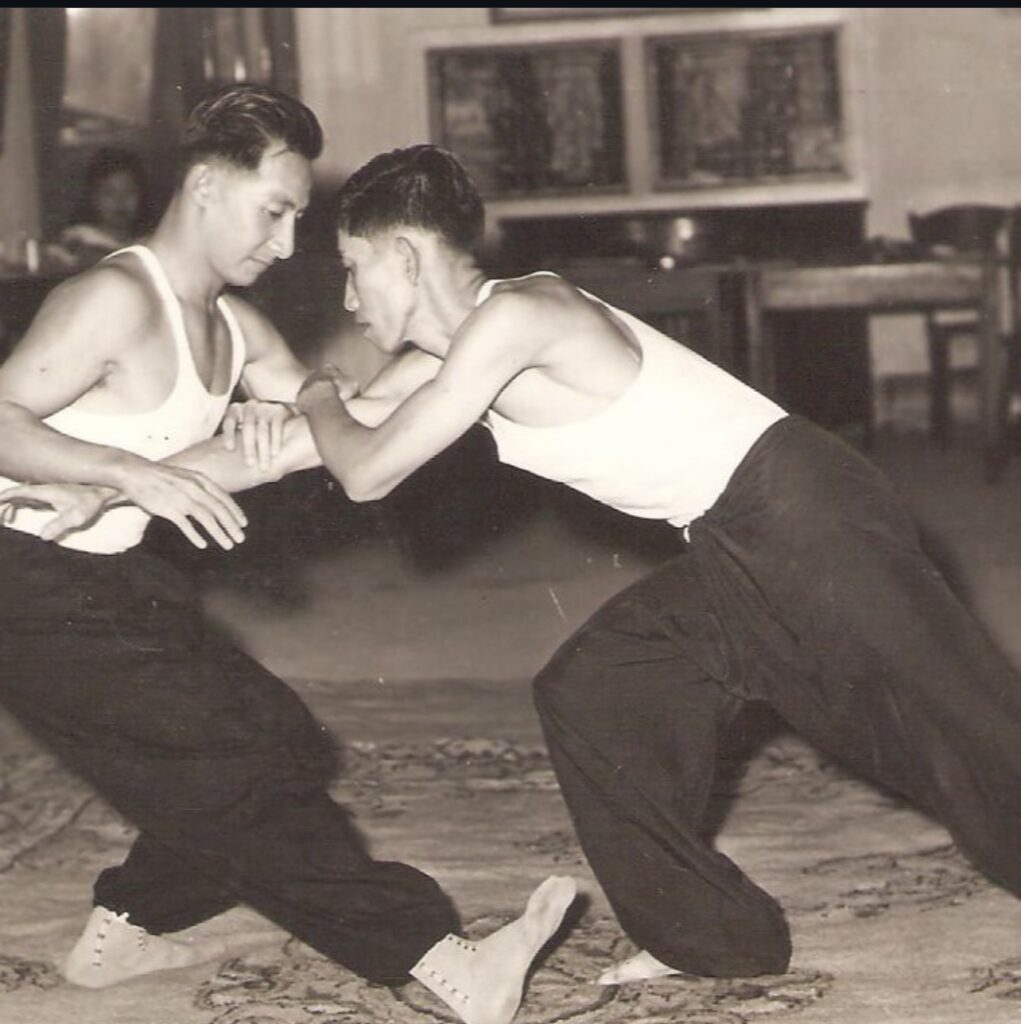
The introduction happened after Cheng Wing-kwong received a letter at his office from his own Tai Chi teacher, Zhao Shouchuan (趙壽川). The letter mentioned that Zhao’s good friend, Master Qi Minxuan (who was also known by his Daoist title, Zhi Meng Ju Shi), was traveling to Hong Kong for a visit and asked Cheng Wing-kwong to look after him.
When Cheng Wing-kwong met Master Qi, they naturally began discussing and testing their Tai Chi martial arts skills with each other. Deeply impressed by Master Qi’s exceptional martial abilities, Cheng Wing-kwong told Cheng Tin Hung about him and personally brought his nephew to meet Master Qi. After carefully observing the young Cheng Tin Hung, Master Qi agreed to take him on as a student.
His “very practical approach” prioritized the martial reality of Tai Chi Chuan over slow-motion aesthetics, ensuring the art remained a viable self-defense system. Qi Min Xuan synthesized the lineage’s requirements into three critical tactical skills:
- Ting (Hearing): The tactile sensitivity to “listen” to an opponent’s intent through contact.
- Hua (Neutralizing): Using the “Theory of Softness” to dissolve incoming force without resistance.
- Fa (Releasing): The explosive application of internal power once an advantage is gained.
A unique strategic feature of this transmission lies in the quality of the Fa (Release). A powerful analogy for this: while “river water” (江河之水) is soft and provides the “buoyancy” (浮力) to support a ship, it can also become a “tidal wave” (怒潮澎湃) capable of overturning the heaviest vessel.
Qi Min Xuan’s emphasis on free-sparring (San Shou) and Pushing Hands (Tui Shou) ensured his students could manifest this tidal wave of power under pressure. This commitment to practical validation formed the foundation for the lineage’s subsequent record-breaking success in open competition.
Empirical testing: The Legacy of Cheng Tin Hung
A strategist knows that a system is only as good as the results it produces in high-pressure environments. Master Cheng Tin Hung proved the efficacy of “Practical Tai Chi” through objective, international success which showed 31 wins from 32 matches. That’s a 98% success record in international full contact competition against highly trained champions from other styles. Though not focused on competition the school participated in the following.
Competitive Records in full contact lei tei championship fights of the Practical Tai Chi team in Hong Kong
| Year | Event Location | Competitor Name | Achievement / Weight Class |
| 1957 | Taiwan | Cheng Tin Hung | Defeated Taiwan Champion Yu Wen Tong |
| 1971 | Taipei | Chen Wo Fu | Heavyweight Class A Champion |
| 1971 | Taipei | He Chao Yu | Middleweight Class A Champion |
| 1971 | Taipei | Zhu Yuan Tu | Lightweight Class B Champion |
| 1971 | Taipei | The Association | South East Asia Team Championship |
| 1973 | Malaysia | Cheng Zeng Qiang | Lightweight Class A Champion |
| 1980 | Malaysia | Dan Docherty | Super Heavyweight Champion |
| 1980 | Malaysia | Tang Zhi Jian | Middleweight Class B Champion |
To achieve these results, the lineage utilizes a “Complete System.” A high-value practitioner must master eight core components:
Tai Chi Chuan (The 119 Form), Tui Shou (Pushing Hands), San Shou (Free-Fighting), Die Pu (Grappling/Falling), Nei Kung (Internal Power), Saber, Sword, and Spear.
The 12 Yin and 12 Yang Nei Kung exercises are the “Dividends of Martial Capital.”
These exercises provide specific physiological benefits: they strengthen internal organs, make blood vessels flexible and resilient, and increase muscle elasticity. Without these dividends, the practitioner has no “Capital” to fund their techniques.. These competitive victories serve as empirical proof that a complete, internal system is functionally superior to fragmented, health-based versions.
The Learner’s Advantage
The journey from the philosophical heights of Chang San Feng and the Beijing success of Yang Lu Chan to the modern arenas of the 20th century demonstrates that Practical Tai Chi is a living, evolving tradition. For the prospective student, training in this specific lineage is an investment in a “proven” and “living” tradition.
The three primary benefits of this lineage are:
- Access to “Martial Capital”: You do not just learn techniques; you invest in the Nei Kungrequired to make blood vessels flexible and organs resilient, providing the internal “Capital” to execute combat plans.
- Verified Combat Logic: The Practical Approach provides the psychological training to prevent the “Double-Weighting” error, ensuring that emotional agitation never leads to a disastrous force-against-force instinct.
- Philosophical Alignment: The I Ching and Tao Te Ching are applied as physics and strategy. You move through the hexagrams from Kun to Qian, ensuring your “buoyancy” can transform into a “tidal wave” at the moment of release.
Joining this lineage is more than joining a class; it is an investment in a system where ancient wisdom and modern empirical results converge. It is a path that is as intellectually profound as it is martially.