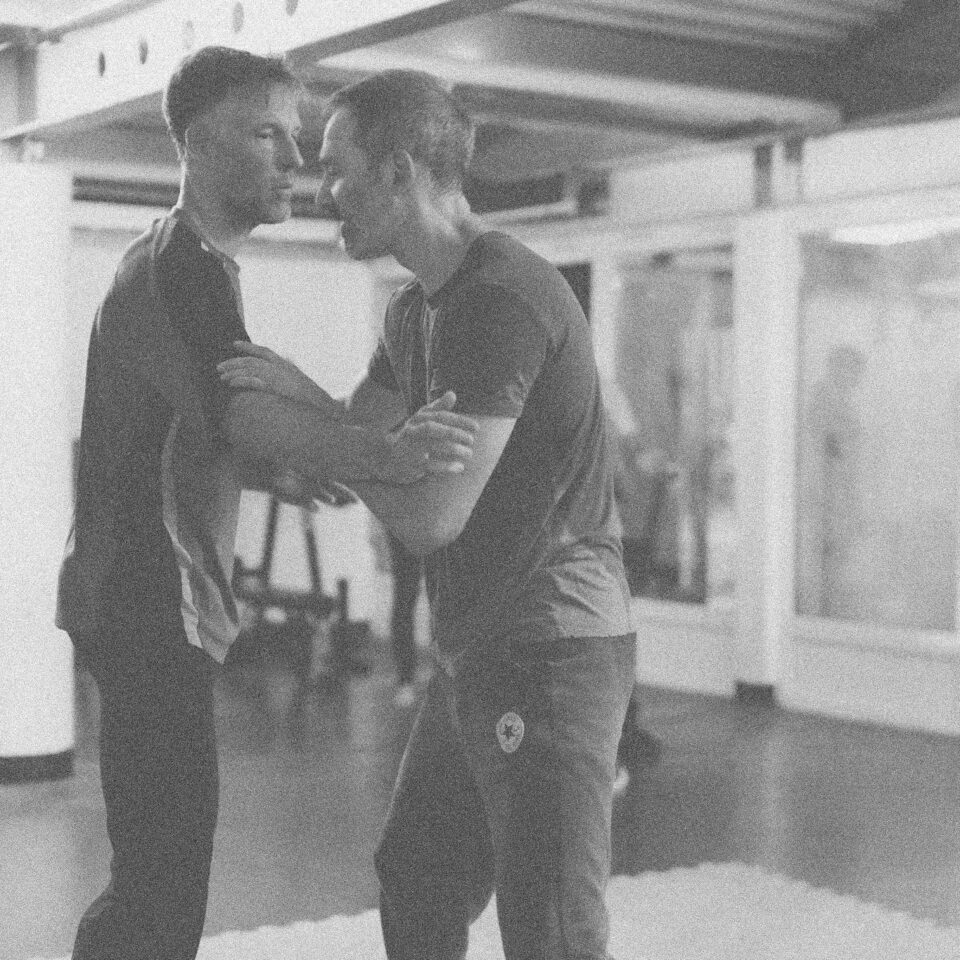



In our system, pushing hands (推手 – tui shou) acts as the essential bridge between the solo form and practical combat (free sparring). It trains the practitioner to physically understand Tai Chi’s core philosophy of yielding to the strong, borrowing force, and overcoming a larger opponent with minimal effort.
The 5 Tactical Principles and 8 Energies The fundamental goal of pushing hands is to train the practical application of the “Eight Energies” (Ba Jin): peng (ward-off), lu (rollback), ji (press), an (push), cai (pluck), lie (split), zhou (elbow), and kao (bump).
To apply these energies successfully without using brute force, the practitioner must adhere to five tactical principles when in contact with the opponent:
- Nian (黏 – Stick): Adhering to the opponent’s incoming force to understand their intent.
- Lian (連 – Connect): Ensuring continuous, unbroken motion so the opponent has no opening to exploit.
- Mian (綿 – Cotton/Soft): Remaining soft and relaxed so the opponent has nothing solid to push against.
- Sui (隨 – Follow): Yielding and following the opponent’s momentum.
- Bu Diu Ding (不丟頂 – Neither lose contact nor resist): Maintaining connection without fighting force with force.
The 8 Training Routines
To develop these skills we have eight specific pushing hands routines, divided into two categories:
- Fixed-Step (定步):
- Four Directions / Double Push Hands (四正推手)
- Elbow Rollback (肘捋推手 – Zhou Lu)
- Bending and Leaning (俯仰推手)
- Silk Reeling (纏絲推手)
- Moving-Step (活步):
- Four Corners / Da Lu (四隅推手 / 大捋步)
- Nine Palaces Step (九宮步推手)
- Seven Stars Step (七星步推手)
- Riding the Wave / Uprooting the Wave (採浪推手 – Choi Long)
The Three Stages of Sensitivity (Listening Power)
Through constant practice of these routines, the nervous system adapts, and the practitioner develops highly tuned tactile reflexes known as “listening power” (聽勁). Our curriculum outlines three distinct stages of mastering this sensitivity:
- Unconscious/Unaware (不知不覺): The beginner stage, where the student is repeatedly pushed off balance and defeated without realizing how or when the opponent issued their force.
- Hindsight (後知後覺): After enough failure and practice, the student begins to feel the attack as it happens, but their physical reflexes are still too slow or weak to neutralize the force in time.
- Foresight (先知先覺): The highest level of mastery. Upon first physical contact, the practitioner can instantly sense the opponent’s intent before they even issue force. This allows the Tai Chi fighter to casually anticipate, neutralize, and control the opponent, achieving a “post-initiation, prior-arrival” counter-attack.
Adapting the Principle While these formal drills are vital, dont get caught up in set routines or labeling techniques. You have to adapt. There is only one technique, that is the principle which everything else comes out of”.