
The “Old Man Burning the Cinnabar”
The Culmination of Internal Strength
In the sophisticated architecture of Tai Chi Neigong (Internal Strength), physical movement is rarely an end in itself; rather, it is a vehicle for cultivating a high-performance internal state.
Within the Cheng Tin Hung lineage, the exercise known as “Old Man Burning the Cinnabar” (Lǎo Sǒu Shāo Dān) serves as the functional “seal” of the entire system. Occupying the critical 12th and final position of the Yang exercises, it marks the definitive transition from active exertion to the deep conservation of vital spirit.
This practice is far more than a simple conclusion. It is a strategic protocol designed to consolidate the bio-energetic output generated during training. By shifting the focus inward, the practitioner moves from the expenditure of power to the “storing and nourishing of the spirit.”
In an era increasingly focused on “breathwork” as a tool for executive resilience, this ancient exercise offers a refined, time-tested methodology for recalibrating the nervous system and achieving a state of “clear and calm” cognitive dominance.
Anatomy of the Practice: Old Man Burning the Cinnabar
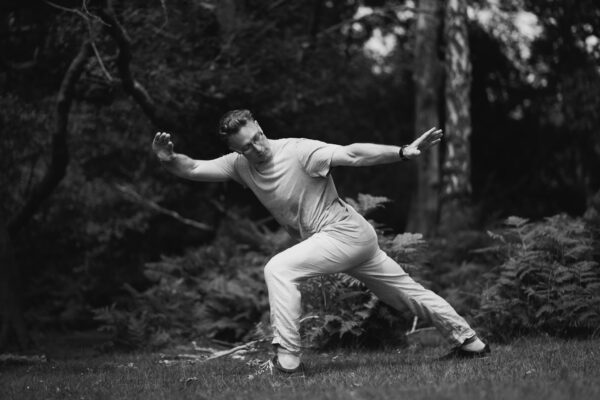
The technical execution of “Old Man Burning the Cinnabar” is defined by its centered stability and a specific bilateral hand circulation. The practitioner assumes a balanced standing posture, maintaining a vertical axis that suggests both rootedness and ease.
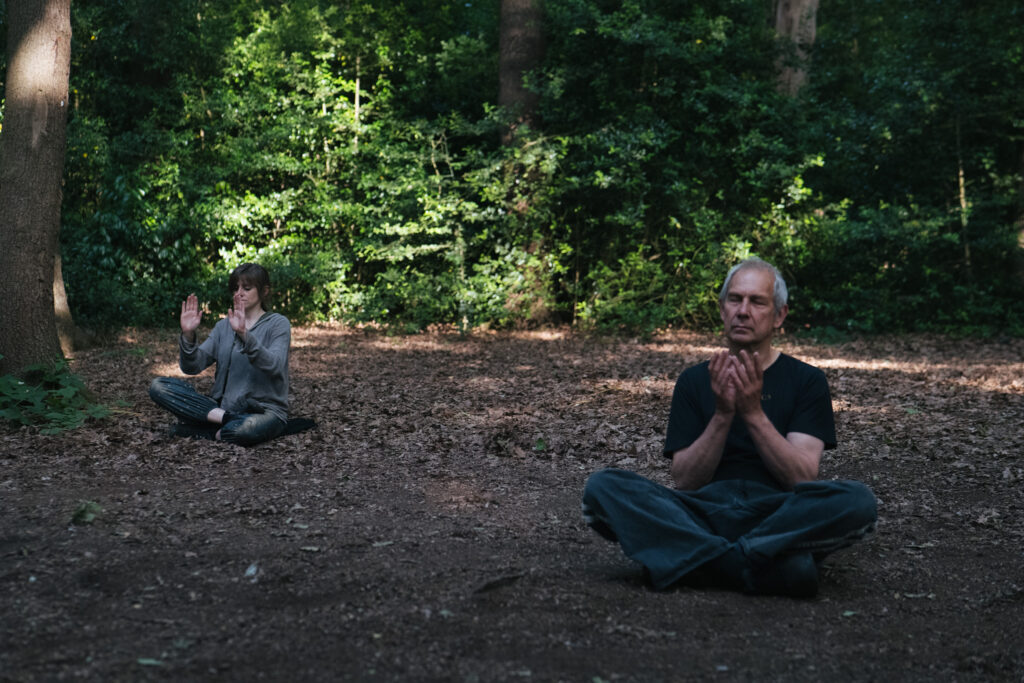
Technical Mechanics: The exercise begins with the hands at the sides, palms facing inward and slightly down. The hands then move in deliberate, circular arcs from the periphery toward the center. As the hands draw toward the “Cinnabar Field” (Dantian) in the lower abdomen, the palms rotate to face the body. The movement concludes with a “seal”—where the hands rest at the Dantian—before returning to the starting position.
The Protocol of Yin-Yang Breathing The core of the practice is the Yin-Yang Breathing (陰陽呼吸) protocol. This is an alchemical exchange described as “吐舊納新” (tǔ jiù nà xīn)—literally “spitting out the old and taking in the new.” This rhythmic cycle involves exfiltrating stagnant, stressful energy (the “old”) and inhaling fresh vitality (the “new”) to “conserve and nourish the spirit” (蓄養精神). This synchronized breathing moves the practitioner beyond mere mechanics, regulating the internal system to store energy rather than dissipate it.
Progression of Practice The depth of the practice is reflected in its progression across three stages. As the practitioner’s internal focus and endurance scale, the repetitions increase significantly.
| Training Stage | Repetitions | Primary Impact |
| Initial Stage | 18 Repetitions | Establishing breath-movement synchronization; initial recalibration. |
| Middle Stage | 111 Repetitions | Building endurance and stabilizing the spirit against external stressors. |
| Late Stage | 333 Repetitions | Mastery of internal focus; deep, permanent conservation of essence. |
Philosophical Foundations: Linking to the Original Tao
“Old Man Burning the Cinnabar” is the physical manifestation of “Inward Training” (Nei-yeh). It provides a concrete method for “aligning the body” and “storing the essence” as championed in the Original Tao. The “Old Man” imagery does not denote frailty; instead, it represents the cultivation of wisdom and the preservation of vitality against the “rigidity of death” (堅強) mentioned in the Taoist source context.
Yin and Yang Assisting Each Other The highest ideal of the practice is “Yin and Yang Assisting Each Other” (陰陽相濟). In the context of performance science, this is not a mere 50/50 balance. Rather, it is a synergistic state where profound physical relaxation (Yin) becomes the fuel that powers heightened mental alertness and intelligence (Yang). By maintaining the “softness” of the Yin state, the practitioner enables the Yang intelligence to manifest without the interference of muscular tension or emotional agitation.
The Functional Edge: Mood, Cognition, and Hemisphere Balance
The “balance” sought by the masters of the Cheng Tin Hung lineage is the ancient precursor to modern neurological “flow states.” By synchronizing bilateral, symmetrical movements with the Yin-Yang breath cycle, the practice encourages the synchronization of the brain’s left (analytical) and right (intuitive) hemispheres.
Cognitive and Emotional Outcomes The practice yields specific high-value outcomes for modern practitioners.
- Mood Regulation: By prioritizing “spirit conservation,” the practitioner achieves emotional stability, becoming “cautious and quiet when facing matters” (臨事慎靜). This prevents impulsive, stress-driven reactions.
- Cognitive Enhancement: The source specifically notes an “increase in intelligence” (智力益增). This aligns with neuroplasticity and focused attention, where the brain becomes more efficient at processing complex variables.
- Performance Reliability: Perhaps the most critical strategic benefit is that the practitioner becomes “unlikely to make mistakes” (不易出錯). By achieving “mental clarity” (理智清醒) and mitigating the noise of cognitive load, the practitioner ensures high-stakes decisions are executed with surgical precision.
The Standalone Breathwork Practice
In a high-stress professional environment, “Old Man Burning the Cinnabar” is a premier candidate for a standalone nervous system reset. It requires zero equipment and minimal space, making it a powerful tool for recalibration during a demanding workday.
Our classes run Mondays and Wednesdays from 6-9pm
Book a class