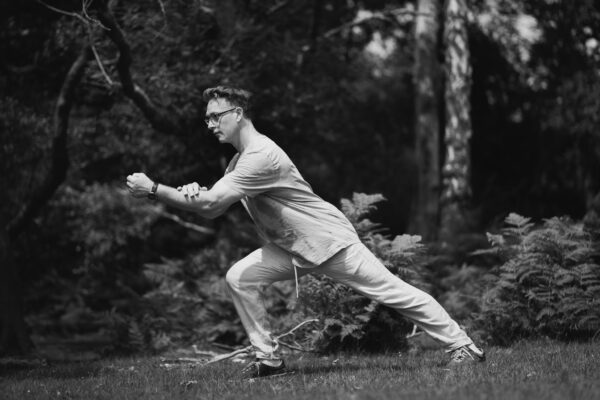

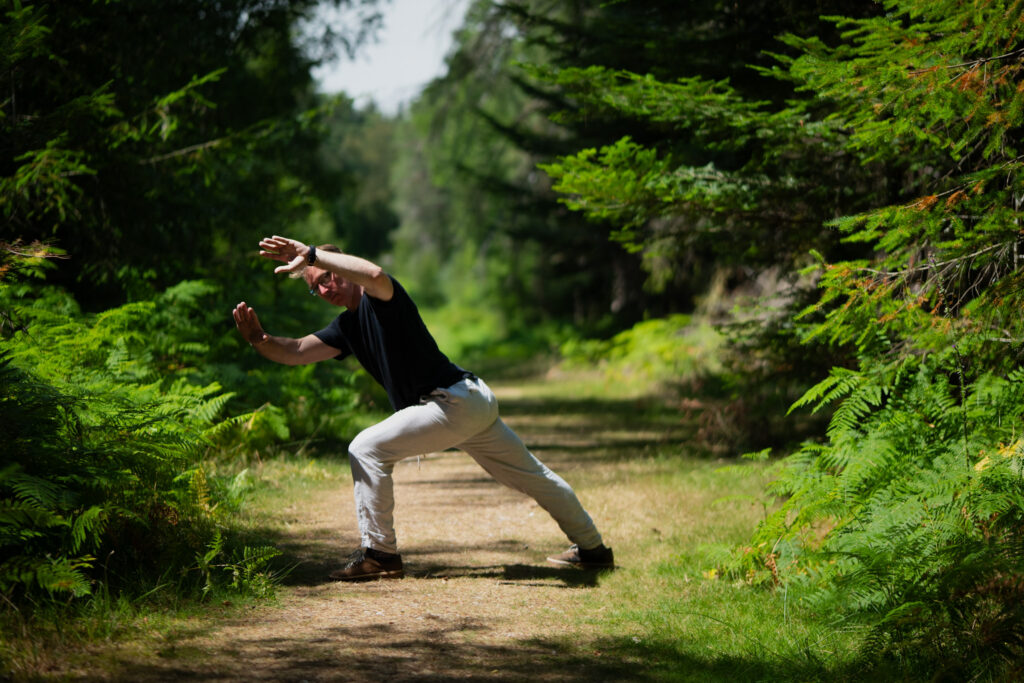
In the venerable Wutan/Wudang tradition (the main combat ready strain of tai chi’ the Hand Form (Tai Chi Chuan) is the bedrock upon which our entire system is built.
It serves as the foundational library for five interrelated components: Hand Form, Pushing Hands, Self-Defence (San Shou), Internal Strength, and Weapons.
We must understand that this art is not a mere sequence of physical movements; it is a mind-led discipline of “thought guiding action.”
Our goal, established by the Taoist Chang San Feng (born 1247 AD), is to achieve maximum effect with a minimum of effort. The hand form provides the core skills to achieve this for both health and wellbeing, as well as fighting prowess.
Knowledge of the Hand Form alone is however insufficient for the grim realities of combat without the mastery of the other four pillars.
The evolution of a practitioner’s skill progresses through two distinct stages of structural and fluid development.
We begin with the Square Form, a simplified, step-by-step methodology. Just as a child must first master the rigid lines of block letters to achieve structural integrity, the student must use the Square Form to “form the letters” of their movement.
Only once this foundation is internalized do we progress to the Round Form. Here, the movements become intricate and flowing, much like cursive script. In the Round Form, the practitioner no longer merely executes techniques; they “write the poem” of fluid, instinctive motion. This progression is the essential bridge from health exercise to sophisticated martial application.
Physiological and Biological development of the practitioner
The cultivation of physical health is the strategic necessity for both longevity and martial proficiency. Grounded in the Taoist search for harmony with nature, the Tai Chi Chuan Hand Form provides a “balanced drill” designed to protect the “spark of life” from being extinguished by age or neglect.
By practicing this alert, graceful discipline, we transform the body into a vessel capable of sustaining high-level internal energy.
THE SPECIFIC BIOLOGICAL ADVANTAGES OF THIS PRACTICE INCLUDE:
- Cardiovascular Enhancement: As the muscles move in a relaxed, deliberate manner, they exert a specialized pressure on the veins, assisting the heart by forcing blood flow back toward it. This improved circulation and the expansion of blood vessels act as a primary safeguard against thrombosis.
- Respiratory Efficiency: We employ the “Tortoise Breathing” method, modeled after the creature whose shell limits outward expansion. By focusing the breath on the Tan Tin (a point 1.5 inches below the navel), the diaphragm expands downward rather than merely outward. This deep, regulated respiration increases oxygen intake and expands the vessels serving the internal organs.
- Internal Organ Function: The rhythmic rising and falling of the diaphragm acts as a literal “massage” for the liver and intestines. This internal stimulation is a traditional remedy for indigestion and a preventative measure against constipation.
- Metabolic Support: Practice protects the vital process of “substitution” (metabolism). In this process, nutrients are conveyed through the medium of the bloodstream to undergo physical and chemical transformations. By optimizing this, Tai Chi Chuan prevents arteriosclerosis and general sickness.
- Neurological Stimulation: Dedicated concentration on the movements stimulates the central nervous system. Because the well-being of every internal organ depends on the integrity of this system, the Hand Form ensures the regulatory capacity of the entire body remains robust.
A sound central nervous system, forged through physical drill, is the non-negotiable prerequisite for attaining true mental tranquillity.
PSYCHOLOGICAL CULTIVATION AND MENTAL ALERTNESS
For the modern “city dweller” besieged by nervous tension and mental strain, the Hand Form offers a strategic sanctuary. Taoism teaches us to “seek tranquillity in motion”—a state where physical slowness fosters a profound peace of mind. This discipline requires no special equipment and only a small area, making it a practical antidote to the chaos of urban life.
The mental and psychological advantages of this training are as follows:
- Cognitive Sharpness: Regular practice develops a mind that is both alert and focused. This clarity facilitates better concentration on routine professional tasks and allows for more effective, decisive decision-making.
- Emotional Regulation: The “tranquillity in motion” sought in our Wutan lineage leads to a shift in disposition. Practitioners become even-tempered and slow to anger, as the soft nature of the practice dissolves systemic tension.
- Mental Discipline: The principle of “thought guiding action” must transcend the training hall. By prioritizing the brain over brawn, we learn to apply intellectual oversight to our daily affairs, ensuring our actions are purposeful.
- Stress Reduction: The soft, slow execution of the form is a direct counter to environmental pressure. By consciously reducing physical tension, the practitioner increases their power of concentration and mental resilience.
This psychological stability provides the necessary clarity to master the Hand Form’s original purpose: the art of San Shou.
FOUNDATIONS FOR SELF-DEFENCE
The Hand Form is the living library of techniques that are eventually modified for combat. Every movement practiced in the slow, health-giving form contains a specific application for self-defence. It provides the mechanical vocabulary required for the advanced stages of Pushing Hands and actual combat engagement.
The martial-specific benefits inherent in the form include:
- Agility and Fluidity: Training with relaxed muscles and tendons allows the joints to rotate smoothly. This lack of internal resistance creates the swiftness required for effective defense.
- Biomechanical Yielding: We embrace the softness that allows a practitioner to yield before a strong attack. As Lao Tzu taught: “The unbending breaks, the yielding survives.” Like bamboo in a gale, we bend to absorb force, only to swing back decisively when the pressure ceases.
- Reactionary Readiness: Through constant practice, these complex techniques become “second nature.” This internalization allows for instinctive reactions in a real situation, where there is no time for conscious thought.
The practice thus completes the circle, weaving health, mind, and martial skill into a single, unified discipline.
HOLISTIC SYNTHESIS OF THE HAND FORM PRACTICE
Ultimately, the Tai Chi Chuan Hand Form seeks to achieve the ideal of Mens sana in corpore sano—a healthy mind in a healthy body.
It is a scientific method that treats the human being as a complete entity. In the Wutan tradition, these profound benefits are not the result of casual effort; they are the returns on an “injection of capital” in the form of constant study and practice.
Ideally, the form should be practiced for fifteen minutes daily. However, true progress is only possible under the guidance of a competent master who can identify faults and demonstrate the subtle relationship between thought and action.
Only through such dedicated investment can one hope to realize the full potential of this ancient Taoist art.