

Physical Strength as Martial “Capital”
In the rigorous architecture of Traditional Wushu, technical proficiency is frequently misperceived as the totality of the art. However, as Master Cheng Tin Hung—the “Tai Chi Fighter” of the century—consistently demonstrated, technique is merely a blueprint.
Without the “capital” of physical strength, even the most sophisticated movement remains bankrupt. Cheng Tin Hung’s philosophy, documented in the Tai Chi Martial Arts Record, posits that a martial artist is like a businessman: strategy is vital, but one cannot trade without capital.
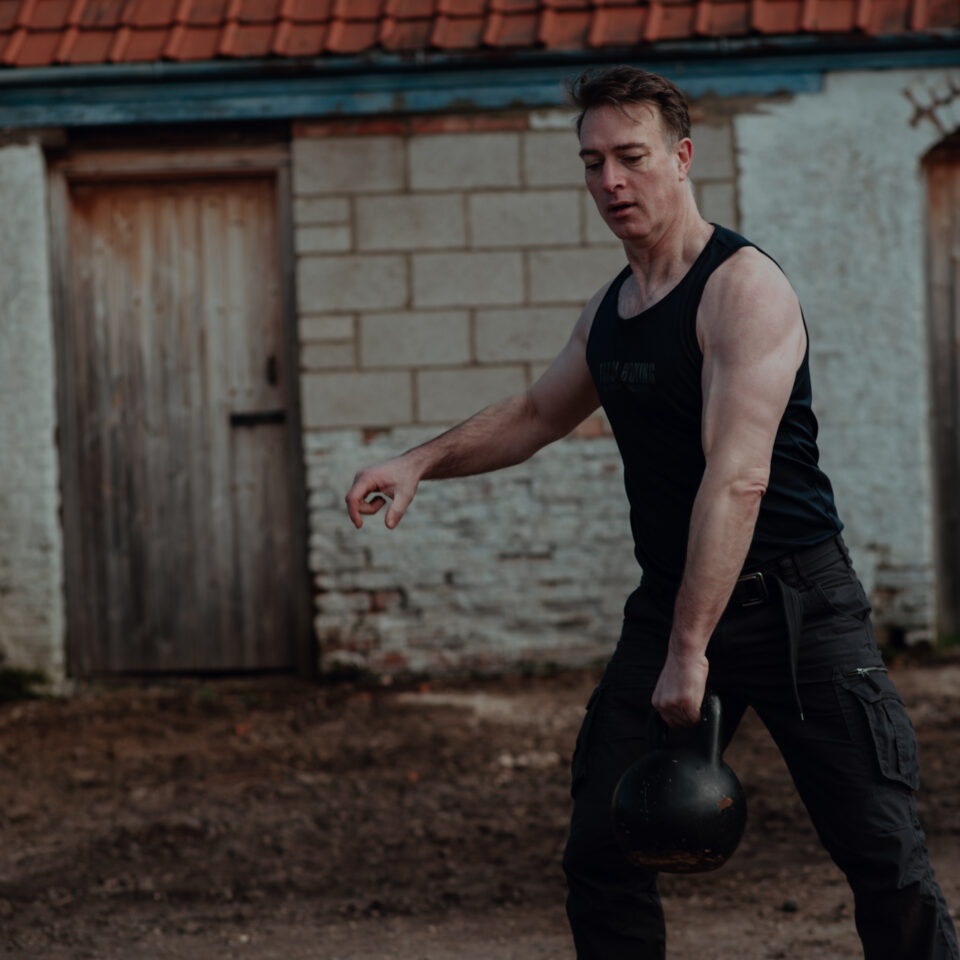
For the modern practitioner, the kettlebell is the premier tool for building this capital. Unlike the linear, balanced load of a barbell, the kettlebell’s offset center of mass requires constant stabilization through the waist and hips. This mirrors the “coiling” mechanics essential to the first level of achievement in Tai Chi Neigong. Resistance training acts as the catalyst for these stages:
- Internal-External Unity: The foundational level where external musculoskeletal action is perfectly synchronized with internal respiratory rhythms.
- Heart-Body Unity: The stage where intent (heart) and physical form act as a single, instinctive entity.
- Heaven-Man Unity: The highest achievement, where movement becomes an effortless expression of universal principles, a state of “forgetting the self.”
By establishing a “firm root” through weighted movement, the practitioner creates a vessel capable of executing Fa Jing(power release) without structural collapse.
Cultivating “Soft Power”: The Intersection of Resistance and Elasticity
Tai Chi demands the cultivation of “Soft Power” (Rou Jin), a quality of force that is fundamentally different from the rigid, exhaustive “Hard Power” of extrinsic styles. The Tai Chi Martial Arts Record famously employs the analogy of the rope vs. the stick: a hard stick is limited by its rigidity, but a soft rope, when swung, can achieve far greater velocity. Softness produces speed; elasticity allows for endurance. By utilizing kettlebells for ballistic movements—such as swings and snatches—we train the body to reach later but arrive first (hou fa xian zhi), using the “softness” of the rope to generate devastating terminal speed.
The following table distinguishes between the restrictive nature of rigid strength and the expansive potential of Tai Chi Soft Power:
| Feature | Rigid Strength (Extrinsic) | Tai Chi Soft Power (Intrinsic) |
| Muscle Quality | Hard, condensed, and tense | Elastic, pliant, and spring-like |
| Energy Consumption | High; rapidly exhausts internal reserves | Low; sustainable through efficient movement |
| Oxygen Supply | Restricted by muscular tension | Plentiful; enhanced by relaxed vascular flow |
| Functional Result | Stagnant power; prone to “Double Heavy” | Fluid speed; “Flexible like a wheel” |
The goal of the modern internal warrior is not the “hard” lifting that results in stagnant power, but the development of “flexible joints” and pliant muscle fibers that allow for the storage and release of kinetic energy.
Physiological Synergy: Health Gains and the “Turtle Breath”
The integration of high-intensity weighted movement with traditional internal protocols offers a unique physiological advantage, particularly in protecting the heart and lungs. Strenuous activity often leads to “horizontal expansion of the chest” (heng xiang kuo zhang), a fault the source warns causes premature fatigue and unnecessary heart burden—a critical concern for middle-aged and elderly practitioners.
To counter this, we apply “Turtle Breathing” (Diaphragmatic breathing), or “Gas Sinking to the Cinnabar Field” (Qi Chen Dan Tian). In this protocol, the lungs expand downward rather than outward, utilizing the diaphragm to massage the internal organs. Performing kettlebell movements under this protocol yields specific health outcomes:
- Natural Breathing: By avoiding chest expansion, the practitioner prevents the “heart-burdening” pressure common in heavy lifting.
- Enhanced Circulation: The “one-pressure, one-upright” motion of the diaphragm acts as a pump, facilitating nutrient delivery to the cells and blood flow to the organs.
- Internal Organ Health: The rhythmic compression provides a gentle “massage” to the stomach and intestines, fostering longevity and vitality.
Power Gains through Neigong Principles: Yin and Yang Sections
Traditional Neigong is divided into two distinct sections: the Yin section, focused on Lian Ti (training the body/vessel), and the Yang section, focused on Lian Jin (training the power). A practitioner must balance these to avoid the error of “Double Heavy”—the state of “resisting force with force” (p. 36). Stagnation occurs when the mind and body become rigid, making one easily manipulated by an opponent.
Kettlebell training, when mapped to the “Twelve Big Hexagrams,” prevents “Double Heavy” by forcing a transition between Yin and Yang. For example, in the kettlebell swing, the “hike” represents Yin (absorption and coiling), while the “float” represents Yang (projection). This training ensures the practitioner remains “flexible like a wheel,” as described in the Tai Chi Classic.
- Elimination of Rigidity: The ballistic nature of the kettlebell prevents the “stiffening” that leads to the Double Heavy error, teaching the body to move between absorption and projection without pause.
- Coiling and Rising/Falling: Kettlebell movements mirror the pan xuan qi fu (coiling and rising/falling) principles, ensuring power is driven by the waist and hips rather than isolated limbs.
- Unbroken Flow: By training against resistance, the practitioner learns to avoid “dead spots” in movement, achieving the state of “Double Weightless” where the body is always in transition and never stagnant.
Summary of the Integrated Routine
The synergy between modern kettlebell resistance and traditional Tai Chi Neigong creates a practitioner who is both structurally resilient and internally fluid. The kettlebell is not a tool for “hardness,” but the very forge used to increase the “capital” of the vessel. When Lian Ti (body training) is synchronized with Lian Jin (power training), the practitioner fulfills the ancient requirement of the internal arts: to be as healthy as they are formidable.
The integration of these principles ensures that power is never forced but is instead “borrowed” from the earth and redirected through a supple frame. For the modern practitioner, this synthesis provides a significant competitive edge in self-defense and a foundation for long-term vitality, ensuring that the internal warrior remains “flexible like a wheel” and structurally unshakeable through every decade of life.